From Live Rooms to Multitrack Recording: How Studios Changed
Trace the history of multitrack recording from early disc sessions to tape, and hear how each studio method changed the way musicians shaped a song.
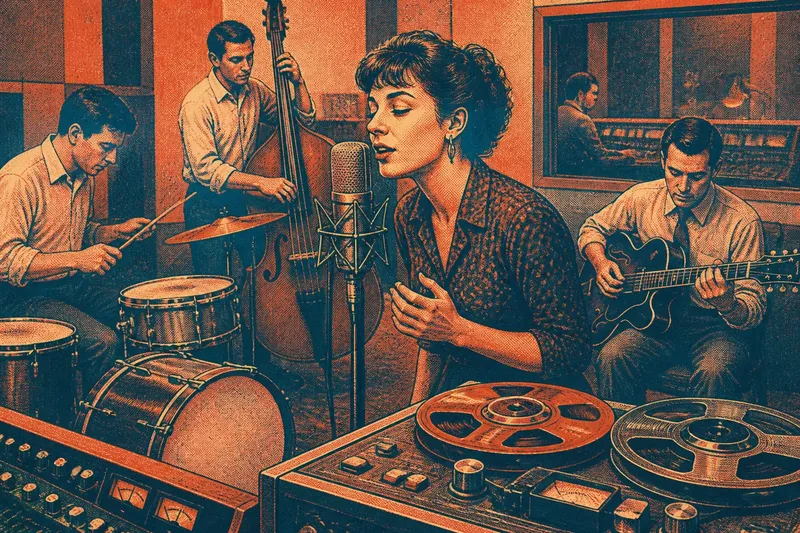
A singer leans towards a microphone for a quiet line while the band holds its place around her. For much of recording history, that shared performance was the starting point; multitrack recording later let musicians preserve separate parts and shape them at different times.
How did early recording capture a band?
In the acoustic era, before electrical microphones became standard, performers sang or played into a large horn that transferred sound mechanically to a cutting device. The process left little scope to alter the balance afterwards: musicians adjusted their positions and playing to suit the horn and one another.
Electrical recording, adopted widely by the end of the 1920s, used microphones and amplifiers to capture sound on disc. It improved the means of recording and balancing an ensemble, but a typical commercial disc session still captured a performance as a combined signal rather than preserving each instrument on its own track.
That distinction matters. A microphone could be moved, and performers could be arranged around it, but changing one instrument’s level after the session was not like moving a fader on an isolated track. If the balance or performance failed, the practical answer was often to adjust the setup and record another take.
What did magnetic tape make possible?
Magnetic tape became an important recording medium in the years after the Second World War. Tape could be edited by cutting and joining sections, making it possible to assemble a performance from selected portions. This was not the same as multitracking: a recording could still contain the whole ensemble mixed together on one track.
In the 1950s, recording studios began adopting tape machines that could preserve multiple tracks separately. Les Paul’s experiments with overdubbing and multitrack machines helped demonstrate how recorded parts could be layered, while studios such as Abbey Road developed their own multitrack facilities. The change came gradually: available track counts and working methods differed by studio and machine.
As multitrack systems developed, engineers and musicians could record parts separately and combine them later. A vocal could be replaced without asking the rhythm section to repeat its performance, and a mix could adjust the level of one recorded part without altering every sound captured alongside it.
How did separate tracks change the work?
Multitracking moved some musical decisions from the room into later recording and mixing sessions. A musician could hear a guide performance, add a part, then respond to how the arrangement sounded in context. Overdubbing also made it possible to create harmonies or layered instruments that would be difficult to perform simultaneously.
The trade-off was that parts recorded at different times had to connect convincingly. Players needed to follow the established pulse and phrasing; otherwise, a technically tidy overdub could feel detached. Separate tracks gave the team more choices, but did not make musical judgement unnecessary.
Say a four-piece band has a strong drum and bass take, but the singer rushes the second verse. The engineer keeps the rhythm tracks, records a new vocal while the singer listens to them, then compares the verse against the original. The decision is to use the new vocal only if its timing and expression fit; otherwise, the band can return to a complete group take.
Did multitracking replace recording together?
No. Bands still record live, and a session can combine group performances with separate overdubs. Musicians might play drums and bass together on isolated tracks, then add vocals and guitar later. They retain the interaction of a shared performance while gaining some freedom to refine individual parts.
The right approach depends on what the song needs. If its character rests on players responding to one another, a live take may suit it. If the arrangement depends on layered vocals or precise changes to individual parts, multitracking can make those choices easier to manage.
What should you listen for in the history of multitrack recording?
What is the difference between overdubbing and multitracking?
Multitracking records separate signals on different tracks so they can be combined later. Overdubbing is the act of recording a new part while listening to material already recorded; it is one way of using a multitrack setup.
Could a live performance be recorded on separate tracks?
Yes. Musicians can play together while microphones feed separate tracks, preserving the shared performance and allowing more control during mixing. Sound can still spill between microphones, so the tracks may not be completely isolated.
Does a recording with a spacious sound prove it was made live?
No. Room sound can come from microphones, effects or mixing choices, and a live ensemble can be recorded with a close, controlled sound. Treat spaciousness as a listening impression, not proof of a particular method.
Why do older recordings often sound like a single performance?
Many early commercial recording sessions captured an ensemble as a combined signal, so the balance and timing were shaped during the performance. Later editing and overdubbing could change a recording’s construction, but the sound alone cannot always reveal the exact process.
How can you compare the methods while listening?
Choose two recordings with noticeably different textures. Listen for whether instruments seem to share a room, whether a vocal sits apart from the band, and whether repeated parts vary in timing or expression. These clues can suggest how a performance was assembled, but they cannot identify the equipment or process with certainty.
Try listening once for the ensemble’s timing and again for the way the parts occupy space. That separates what the musicians appear to do together from what production may have shaped later.
Which recording approach suits a song?
- Live ensemble: If the parts depend on spontaneous responses, record the players together; if the balance or performance does not work, adjust the arrangement or try another take.
- Separate tracks: If one part needs revision without repeating the rest, record it on its own track; if the new part feels disconnected, record it with more of the ensemble present.
- Hybrid session: If the rhythm section’s interaction is central but the vocal needs attention, capture the rhythm section together and add the vocal later; if the added vocal does not fit, revisit it alongside the players.
- Overdub: If a harmony or extra line cannot be performed alongside the existing part, record it while listening to the track; if its phrasing fights the arrangement, simplify or re-record the line.
- Disc-era ensemble capture: If you are studying a recording made for a single mixed signal, listen for how performers balance themselves during the take; if you cannot separate individual parts by ear, avoid assuming the original session had isolated tracks.
- Edited tape performance: If a passage sounds assembled from separate sections, listen for changes in ambience or continuity; if there is no clear audible seam, treat editing as a possibility rather than a conclusion.
Multitrack recording history is most useful as a way to hear where musical choices were made: in the room, across separate takes, or in the mix. Listen for the relationship between the parts, then let the sound guide your judgement rather than guessing the studio process from one clue.