The Myth of the Perfect First Listen
The perfect first listen can miss a song’s character. Learn how a few focused replays reveal its shape, sound and appeal without turning listening into homework.
You press play while making tea, and the kettle drowns out the first verse. By the time you sit down, the song has already moved on. The perfect first listen is a poor test: a track may make more sense when you give it your attention, but it still may not be for you.
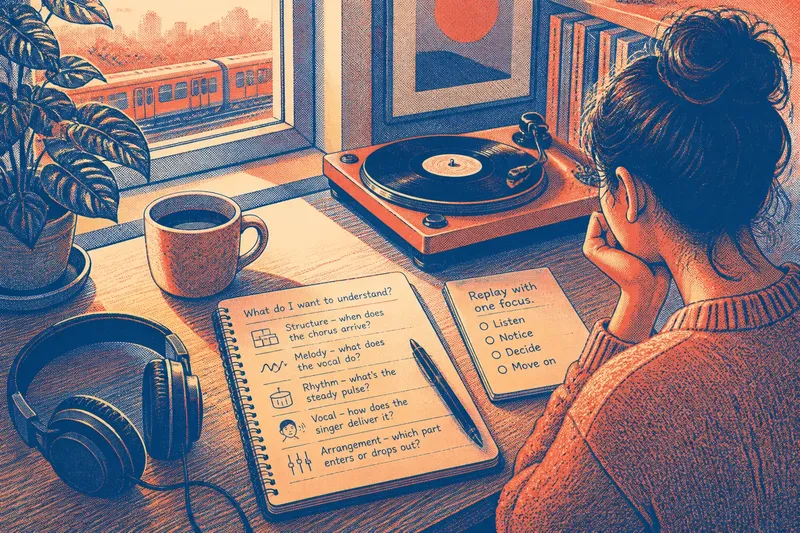
Instead of replaying and hoping for a change of heart, decide what you want to understand. You might be curious about how the chorus arrives, why the vocal feels distant, or what makes the rhythm seem unsettled. A clear question makes a return useful without turning a song into homework.
Why can a song miss on the first listen?
A first impression depends partly on what you can hear and partly on what you expect. Conversation may cover a quiet lyric; a dense arrangement may obscure the beat; an unfamiliar vocal style may take time to feel inviting. These are reasons to listen again if you are curious, not reasons you must learn to like the song.
A first pass also tends to draw attention to the most prominent sound. The lead voice or main beat may hold your ear while a change in harmony, a pause, or a backing part passes unnoticed. Once you know the broad shape, you can choose whether a particular detail deserves attention.
Treat replay as a way to clarify your reaction. If the song remains uninteresting, moving on is a reasonable result.
How should you listen to a song again?
Start with the question that brought you back, then choose one audible detail that could help answer it. If you are unsure why the chorus feels flat, listen for what changes when it begins. If the vocal seems hard to connect with, notice its tone and phrasing rather than trying to catch every word.
- If the first listen was interrupted: Check whether you can give the song an uninterrupted pass; if you can, follow where it changes section, and if you cannot, save it for a quieter moment instead of judging the muddled impression.
- If the arrangement sounds crowded: Check whether one part is easiest to track, such as bass or backing vocals; if you can follow it, use that as your focus, and if no part stands out, listen for a clear entrance or pause instead.
- If the chorus feels forgettable: Check whether its melody or accompaniment changes from the verse; if you hear a change, note what it is, and if you hear none, consider whether repetition itself is the song’s effect.
- If the lyrics are unclear: Check whether a repeated phrase is audible; if it is, follow how the singer delivers it, and if it is not, shift attention to melody or vocal tone rather than raising the volume uncomfortably.
- If the rhythm feels confusing: Check whether you can tap along to a steady pulse; if you can, listen to how the other parts play around it, and if you cannot, notice a repeated drum or bass figure instead of forcing a count.
- If you already know you dislike it: Check whether you still have a question about the song; if you do, make one return to answer it, and if you do not, stop rather than trying to persuade yourself into a different reaction.
Choose the smallest question that could change what you understand.
What can a focused replay reveal?
You do not need to identify chords, instruments or recording methods to describe what you hear. Keep the observation plain: the bass drops out before the chorus, the singer stretches the last word, or a second voice answers the lead. Those details are useful because they are audible, not because they require technical labels.
Say you hear an invented song while waiting for a train, and its chorus seems dull. You decide to check whether anything changes at the chorus entrance. On the next listen, you notice that the drums stop briefly and the singer holds the opening note; you then decide the restrained entrance is deliberate, though you still do not enjoy it. The replay has answered your question without requiring a favourable verdict.
If you lose track of the detail, do not rewind again and again. Let the song continue, then decide whether the question still matters enough for another listen.
What should you listen for when a song feels unclear?
Use these prompts to match your attention to the point of uncertainty. You do not need to cover them all.
- Structure: Notice where a verse, chorus or bridge begins, and whether the ending resolves, repeats or cuts off.
- Melody: Follow one recurring vocal or instrumental phrase. Listen for a held note, a changed ending or a shift in the singer’s delivery.
- Rhythm: Attend to a steady pulse, then notice whether the drums, bass or other parts sit tightly with it or pull against it.
- Vocal expression: Listen for changes in emphasis, breath, tone or distance. You can understand the character of a performance without knowing every lyric.
- Arrangement: Follow one part as it enters, drops out or takes on a different role. Describe what happens rather than guessing how it was recorded.
If the detail you chose is too hard to follow, switch to a clearer one. Listening should answer a question, not become an exercise in proving your concentration.
What do listeners often ask about replaying a song?
How many times should I listen to a song?
There is no required number. Make another pass only while you have a question or genuine curiosity; stop when you are hearing the same thing without gaining clarity.
Should I use headphones?
Headphones may make a quiet sound easier to hear, while speakers can suit a more casual listen. Choose a comfortable option and keep the volume at a level that does not strain your ears.
Do I need to understand the lyrics?
No. You can attend to the melody, vocal tone, rhythm or repeated sounds without understanding every word. If the words are central to your interest, consult an authorised lyric source.
What if I still do not like the song?
That is a complete answer. Listening more closely can help explain your reaction, but it does not oblige you to change it.
When is it better to stop replaying?
Stop when you have answered the question that brought you back. You may now hear why the chorus feels restrained, or you may have confirmed that the vocal style does not suit you. Either outcome gives you a clearer basis for deciding what to play next.
You can also leave the song alone and return only if it comes to mind later. A break removes the pressure to prove that repeated listening works. If you do come back, choose a fresh question rather than replaying with the vague hope that the song will eventually click.
For a song you are undecided about, the useful habit is not endless replay but a clear stopping point: ask one question, listen for an audible answer, and decide whether you want to continue. That keeps the pleasure of listening in charge of the process.