Plectrum or Fingers: Two Ways to Shape a Guitar Part
Plectrum or fingers changes a guitar part’s attack and role. Compare the same phrase clearly, then choose the touch that leaves room for the song.
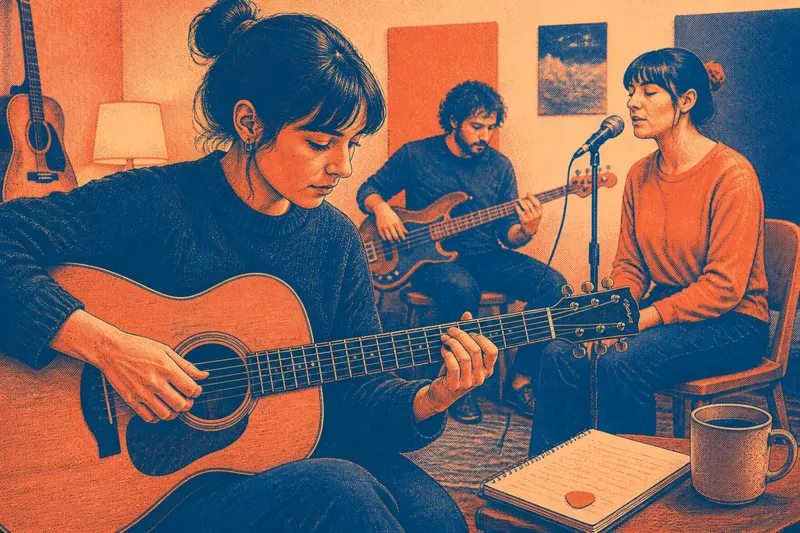
In a small rehearsal room, a guitarist reaches the second verse and hears the same chord pattern land too sharply against the singer’s quiet line. The question is not simply plectrum or fingers: each changes how a note begins, how it connects to the next, and what the part can do inside the song.
Imagine a fictional guitarist, Mara, working on an invented song built around a low vocal, a steady bass line and a repeating guitar progression. She has learnt the part with a plectrum, but the strumming crowds the words. Rather than replacing the arrangement, she compares two ways of playing the same material and listens for what changes.
What does the plectrum change first?
Mara starts with a medium plectrum and plays the verse’s chord pattern as downstrokes. The pick gives each string a clear, focused onset. Even when she plays gently, the initial contact is distinct, so the rhythm remains easy to follow beneath the vocal.
That definition can help a guitar part mark time or give a riff a firm edge. Alternate picking—moving down and up across the strings—also makes repeated notes and quick melodic figures straightforward. A relaxed hand and light touch can keep the attack neat without making it forceful.
But the plectrum can make uneven string hits more obvious. If Mara catches the top strings harder than the lower ones, the chord may sound lopsided. She tries smaller downstrokes, keeping the pick close to the strings, and the pattern becomes more contained without losing its pulse.
Ask whether the part needs a crisp beginning to each beat. If the attack keeps pulling attention from the vocal, try a lighter stroke or another touch.
What do fingers add to the same pattern?
Mara sets the pick aside and uses her thumb for the lower strings, with her index and middle fingers on the higher ones. The notes arrive with a softer edge, and she can let a bass note sound while placing a lighter chord above it. The same progression now feels less like one block of sound.
Fingerpicking gives each digit a separate job. A thumb can keep a regular bass pulse while the fingers answer with short upper-string notes, or the guitarist can pluck a chord in a chosen order rather than brushing through it all at once. That independence can give a simple harmony its own internal movement.
There is no single fingerstyle tone. Plucking with the fleshy part of a fingertip tends to soften the contact; a fingernail can produce a brighter edge. Hand position and the angle of release also affect the sound, so listen to the notes rather than assuming fingers must sound warm.
Mara notices a trade-off: her thumb-and-finger pattern feels less even at first. She slows the phrase and gives the bass and upper notes distinct roles instead of asking every finger to imitate a strum.
How can you compare plectrum or fingers fairly?
Use a short phrase and keep the musical material steady. The aim is not to make both versions identical in tone, but to hear whether the difference in attack and note connection helps the song.
- Choose one chord or short progression and decide on a steady tempo. Keep the chord order and rhythm the same for both passes.
- Play the phrase with a plectrum, using a relaxed stroke. Notice whether the note beginnings are clear and whether any string jumps out.
- Play the same phrase with your thumb and fingers. Keep the tempo and chord order unchanged, and notice whether the notes connect or separate differently.
- Compare the two passes at a similar playing volume. Listen first to the onset, then to how long each note rings and whether one version leaves more space around the vocal or another instrument.
- Choose the version that serves the phrase. If the plectrum makes the beat clearer without crowding the singer, keep it; if fingers separate the bass and upper notes more usefully, use that approach. If neither does both jobs, try a narrower strum or a simpler finger pattern.
Say Mara’s invented verse has a low vocal, steady bass and a repeating four-chord progression. She plays the phrase once with a plectrum, keeping the same chord order and pulse, and hears the attack clearly but notices the upper-string strum masks the end of a lyric. She repeats it with her thumb on each chord’s bass note and two light upper notes between vocal phrases; the bass remains present, while the words have more room. Her decision is to fingerpick the verse and reserve the plectrum for the chorus, where a firmer beat is useful.
Which details should you listen for?
Can you switch between plectrum and fingers?
Yes. A guitarist can hold a pick while plucking selected strings with spare fingers, or put it down between sections. Choose the approach that lets you make the transition without interrupting the phrase.
Will fingers always sound softer than a plectrum?
No. A firm finger pluck can have a sharp attack, while a gentle pick stroke can sound delicate. Compare the same string and note at a similar volume: if one has a clearer initial contact, that is the version with the more distinct onset; if its sound also fades sooner, the difference includes the note’s length, not only its attack.
Which approach suits arpeggios?
Both can work. Fingers make it natural to assign different strings to different digits, while a plectrum can pick notes in sequence with a consistent stroke. Choose by the pattern’s timing and the way you want its notes to connect.
What if the part sounds uneven?
Listen for one specific cause: a string that jumps out, a note that arrives late, or a beat that loses its shape. Reduce the movement and repeat a short phrase slowly before changing the whole arrangement.
How should the guitar support the song?
Mara returns to the verse with one question: what should the listener notice? The vocal carries the lyric, while the bass already supplies a steady foundation. A full strum would add another continuous layer; a lighter fingerpicked figure could leave room around the words while still outlining the harmony.
For the chorus, her invented arrangement calls for a firmer rhythmic lift. Mara brings back the plectrum, plays a narrower set of strings and lets the strum follow the vocal’s phrasing. The change is audible because the articulation changes with the section, not because she has added more notes.
She keeps the fingerpicked verse pattern simple: thumb on the bass note at the start of the chord, then two higher notes between vocal phrases. When the singer holds a word, Mara avoids filling every gap. The guitar’s job is to answer and support, not to demonstrate how many strings she can reach.
The decision is about musical role as much as hand technique. A pick can make a repeating figure speak clearly; fingers can separate bass and treble into complementary lines. Either can be restrained or prominent, depending on touch, rhythm and the space the song leaves.
When deciding between plectrum or fingers, compare the same phrase at a similar volume and keep its tempo and chord order steady. If the attack is clearer but the vocal feels crowded, narrow the strum; if the bass and treble gain useful separation, keep the fingerpicked pattern. Let that observable difference shape the guitar part.